Understanding the Michigan State Budget: Where Does the $80+ Billion General & School Aid Fund Go?
A forensic financial breakdown of Michigan's enacted $82+ billion state budget: How tax dollars are apportioned between the General Fund and School Aid Fund, per-pupil K-12 foundation grants, Medicaid matching, and the Consensus Revenue Estimating process.
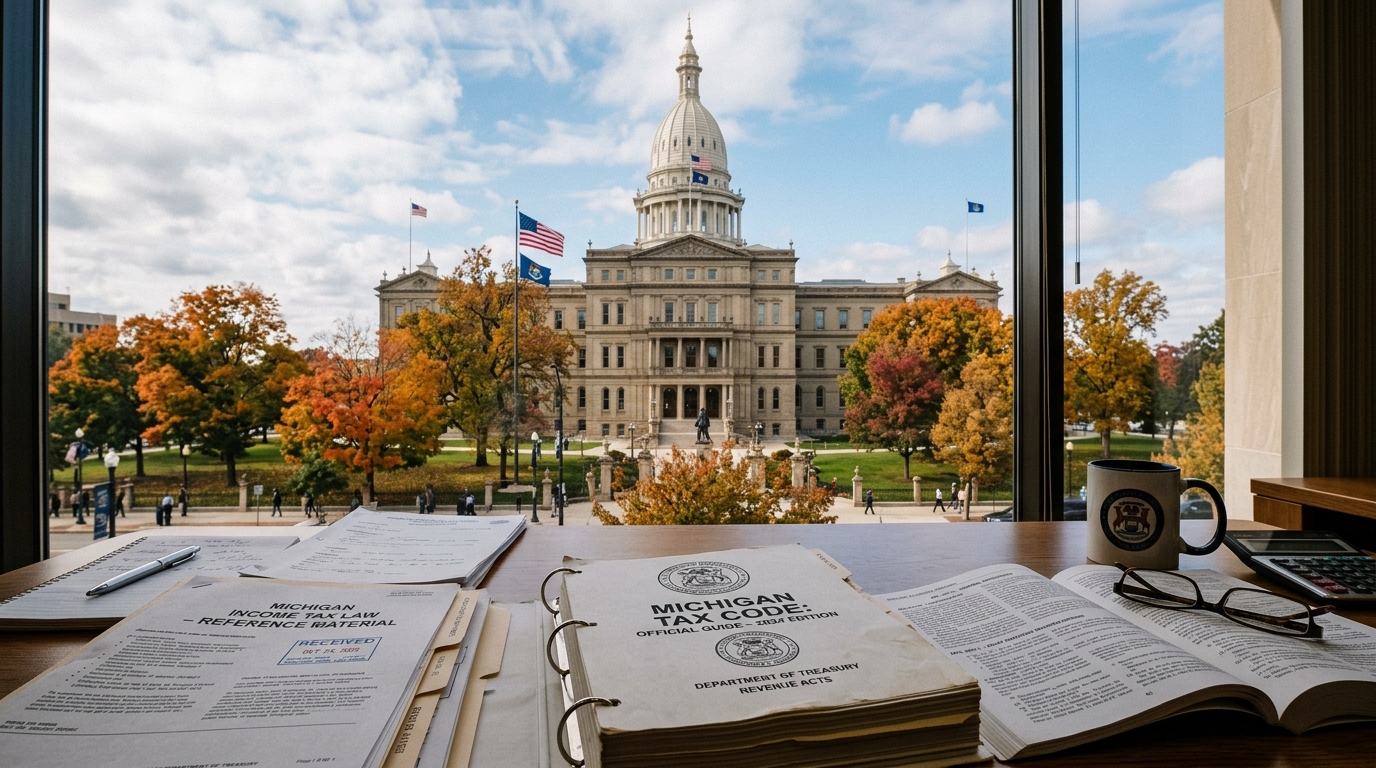
Every year between January and July, the corridors and committee rooms of the Michigan State Capitol in Lansing become the battleground for one of the most consequential fiscal negotiations in the American Midwest: the drafting and enactment of the State of Michigan annual budget.
At more than \$82 billion, Michigan’s enacted state budget represents an immense aggregation of public capital. It touches virtually every aspect of daily life across the state’s two peninsulas—funding the operations of 83 county health departments, state trooper patrols along 9,600 miles of highway, tuition support for 15 public universities, corrections facilities housing over 30,000 inmates, and daily classroom instruction for 1.4 million K-12 schoolchildren.
Yet, despite its scale, the mechanics of state spending remain widely misunderstood. Taxpayers frequently assume that all state taxes flow into a single, unrestricted bank account that lawmakers spend at their discretion.
In reality, Michigan operates under a highly segmented, constitutionally rigid budgetary framework. More than 80% of all state revenue is legally restricted by the state constitution or federal statutory mandates, leaving lawmakers with direct discretionary control over a surprisingly narrow slice of the total budget.
This forensic fiscal analysis breaks down where Michigan’s tax dollars originate, how funds are apportioned between the General Fund and the School Aid Fund, the role of federal Medicaid matching dollars, and how the state navigates the semi-annual Consensus Revenue Estimating Conference (CREC).
Bottom Line Up Front (BLUF): Michigan State Budget Architecture (2026)
• Total Enacted State Budget: Approximately $82.5 Billion.
• Federal Grant Inflows: $32.8 Billion (39.7%) — Primarily federal Medicaid matching, SNAP food assistance, and federal highway grants.
• School Aid Fund (SAF): $20.4 Billion (24.7%) — Constitutionally restricted strictly to K-12 education, community colleges, and higher education.
• General Fund / General Purpose (GF/GP): $15.2 Billion (18.4%) — The state's true discretionary operating budget.
• Dedicated Special Revenue & Transportation: $14.1 Billion (17.2%) — Gas taxes, vehicle registrations, hunting/fishing licenses, and regulatory fees.
1. Where Does Michigan’s Revenue Come From?
To understand how Michigan spends \$82+ billion, one must first trace the revenue streams that feed the state treasury in Lansing:
| Revenue Source | Annual Collection | Percentage of State-Generated Revenue | Primary Destination Fund |
|---|---|---|---|
| Individual Income Tax (4.25% Flat) | $13.2 Billion | 27.5% | General Fund (~75%) & School Aid Fund (~25%). |
| State Sales Tax (6.0%) | $10.8 Billion | 22.5% | School Aid Fund (73.3%), Revenue Sharing, CTF. |
| State Education Property Tax (6 Mills) | $2.6 Billion | 5.4% | School Aid Fund (100% dedicated to K-12). |
| Corporate Income Tax (6.0% CIT) | $2.1 Billion | 4.4% | General Fund / SOAR Strategic Fund. |
| Transportation Taxes (Gas & Tabs) | $3.8 Billion | 7.9% | Michigan Transportation Fund (Act 51 roads). |
| Michigan State Lottery Net Proceeds | $1.3 Billion | 2.7% | School Aid Fund (100% dedicated). |
| Use Tax, Tobacco, Liquor & Cannabis Levies | $3.1 Billion | 6.5% | Split: General Fund, School Aid, Local Municipalities. |
| Federal Matching Grants | $32.8 Billion | — (Federal Transfer) | Medicaid (MDHHS), Federal Transit, Title I Education. |
2. The Great Divide: General Fund vs. School Aid Fund
The defining architectural feature of Michigan public finance is the structural separation between the General Fund / General Purpose (GF/GP) and the School Aid Fund (SAF).
THE TWO ENGINES OF MICHIGAN PUBLIC SPENDING:
┌──────────────────────────────────────┐  ┌──────────────────────────────────────┐
│ GENERAL FUND / GENERAL PURPOSE       │  │ SCHOOL AID FUND (SAF)                │
│ Total: ~$15.2 Billion                │  │ Total: ~$20.4 Billion                │
├──────────────────────────────────────┤  ├──────────────────────────────────────┤
│ • Discretionary state operations     │  │ • Constitutionally ring-fenced       │
│ • Department of Corrections (Prisons)│  │ • K-12 Foundation Grants per pupil   │
│ • State Police & Public Safety       │  │ • Special education services         │
│ • Public University Operations       │  │ • Pre-K Great Start Readiness        │
│ • Health & Human Services State Match│  │ • At-Risk pupil support funding      │
└──────────────────────────────────────┘  └──────────────────────────────────────┘
Why Lawmakers Cannot Freely Reallocate Money
Prior to 1994, public schools were funded almost exclusively through local property taxes, creating massive spending disparities between affluent suburbs and property-poor urban and rural districts.
Under the landmark passage of Proposal A of 1994, voters amended the Michigan Constitution to slash local school property taxes and create the state School Aid Fund, financed by increasing the state sales tax from 4% to 6%, establishing a 6-mill State Education Tax, and directing all net lottery proceeds to education.
Because the School Aid Fund is constitutionally protected, lawmakers cannot legally raid school funds to fix roads, build state prisons, or patch general operating shortfalls. Conversely, lawmakers frequently face political battles when using General Fund dollars to supplement university budgets or early childhood programs.
3. Departmental Spending: Where the Money Goes
When looking across all state departments, funding is heavily concentrated in two massive entities: the Michigan Department of Health and Human Services (MDHHS) and the Michigan Department of Education / School Aid.
| State Department / Budget Area | Total Gross Appropriations | Key Programs & Spending Priorities |
|---|---|---|
| Health & Human Services (MDHHS) | $35.6 Billion | Medicaid coverage for 2.8M residents, child welfare, mental health, behavioral crisis. |
| K-12 School Aid Budget | $19.8 Billion | Per-pupil foundation grants ($9,600+), universal school meals, special ed, pre-K. |
| Transportation (MDOT) | $6.8 Billion | State freeway rehabilitation, bridge reconstruction, Act 51 local road transfers. |
| Department of Corrections (MDOC) | $2.2 Billion | Operation of 26 correctional facilities, 31,000 inmates, parole supervision. |
| Higher Education & Community Colleges | $2.6 Billion | 15 public state universities (U-M, MSU, Wayne State), 28 community colleges, MI Reconnect. |
| State Police & Military Affairs | $1.1 Billion | State trooper highway patrols, crime forensic labs, National Guard readiness. |
| Treasury & Municipal Revenue Sharing | $1.8 Billion | Statutory and constitutional payments to 1,700 cities, villages, and townships. |
| Environment, Great Lakes & Energy (EGLE) | $1.2 Billion | Municipal water infrastructure, lead service line replacement, PFAS remediation. |
4. The K-12 Foundation Allowance: The Per-Pupil Engine
The single most scrutinized line item in Michigan government is the K-12 Foundation Allowance—the guaranteed dollar amount sent to public school districts for each enrolled full-time student:
K-12 PER-PUPIL FOUNDATION ALLOWANCE TRAJECTORY:
• 1994 (Proposal A Baseline):   $5,000 per pupil
• 2010 (Post-Recession Freeze):  $7,316 per pupil
• 2020 (Target Equity Level):   $8,111 per pupil
• 2026 (Enacted Foundation):    $9,608+ per pupil
In addition to the standard foundation grant, the state budget allocates dedicated categorical grants: * Universal Free School Breakfast & Lunch: Michigan provides state-funded breakfast and lunch to all 1.4 million public school students, regardless of household income. * The “At-Risk” Program (Section 31a): Delivers weighted supplemental dollars to high-poverty urban and rural districts (such as Detroit Public Schools Community District and Flint) to fund literacy coaches, mental health counselors, and tutoring interventions. * Great Start Readiness Program (GSRP): State-funded, tuition-free preschool for qualifying four-year-olds.
5. The Consensus Revenue Estimating Conference (CREC)
Unlike the federal government—which can finance budgetary shortfalls through deficit spending and Treasury bond issuance—Article IX, Section 26 of the Michigan Constitution mandates a balanced budget. The Legislature cannot legally appropriate a single dollar more than certified revenue forecasts.
To prevent political manipulation of revenue estimates, Michigan utilizes the Consensus Revenue Estimating Conference (CREC), codified under Public Act 72 of 1979.
Held twice annually in the State Capitol building (in January to guide the Governor’s executive budget presentation, and in May prior to final legislative passage): * The three voting principals are the State Budget Director, the Director of the Senate Fiscal Agency, and the Director of the House Fiscal Agency. * Economists from the University of Michigan and national forecasting firms present econometric models tracking automotive assembly volumes, employment rates, consumer sentiment, and inflation. * The three principals must reach an unanimous, legally binding consensus on the exact dollar amounts expected to flow into the General Fund and School Aid Fund over the next two fiscal years.
6. The Budget Stabilization Fund: The “Rainy Day” Reserve
To insulate public services against Michigan’s historically volatile automotive manufacturing cycles, the state maintains the Counter-Cyclical Budget and Economic Stabilization Fund (BSF), commonly known as the “Rainy Day Fund.”
Under MCL 18.1351, when real Michigan personal income grows by more than 2% in a calendar year, statutory formulas mandate automatic deposits of surplus tax collections into the BSF. Conversely, during economic recessions when personal income contracts, lawmakers can legally withdraw funds to prevent emergency spending cuts to public schools or public safety.
In 2026, Michigan’s Rainy Day Fund maintains a robust balance of approximately \$1.8 to \$2.0 Billion—providing a critical fiscal buffer against macroeconomic shocks and auto industry restructuring.
Conclusion: Civic Accountability in State Public Finance
Understanding Michigan’s \$82+ billion budget empowers residents, business owners, and municipal leaders to hold state officials accountable. Far from an abstract ledger in Lansing, state budget decisions directly dictate the quality of local schools, the maintenance of regional roadways, the affordability of higher education, and the tax credits available on personal tax returns.
To examine how individual and corporate taxes fund this budgetary apparatus, explore our comprehensive analyses on Michigan State Income Tax Rates & Schedule 1 Rules and Michigan Gas Tax and Road Funding Distribution.
Archival & Citation Notice
This research analysis is published under the academic and civic archive of Detroit Focus. For academic referencing or press reproduction, please cite as: "Understanding the Michigan State Budget: Where Does the $80+ Billion General & School Aid Fund Go?", Detroit Focus Urban Review (October 08, 2026).