Michigan State Tax Refund Status 2026: Direct Deposit Dates, Schedule & Where's My Refund Tracker
A definitive resident guide to tracking your Michigan individual tax refund in 2026: Treasury processing timelines, direct deposit batch cycles, step-by-step instructions for the official Where's My Refund tool, and resolving identity verification holds.
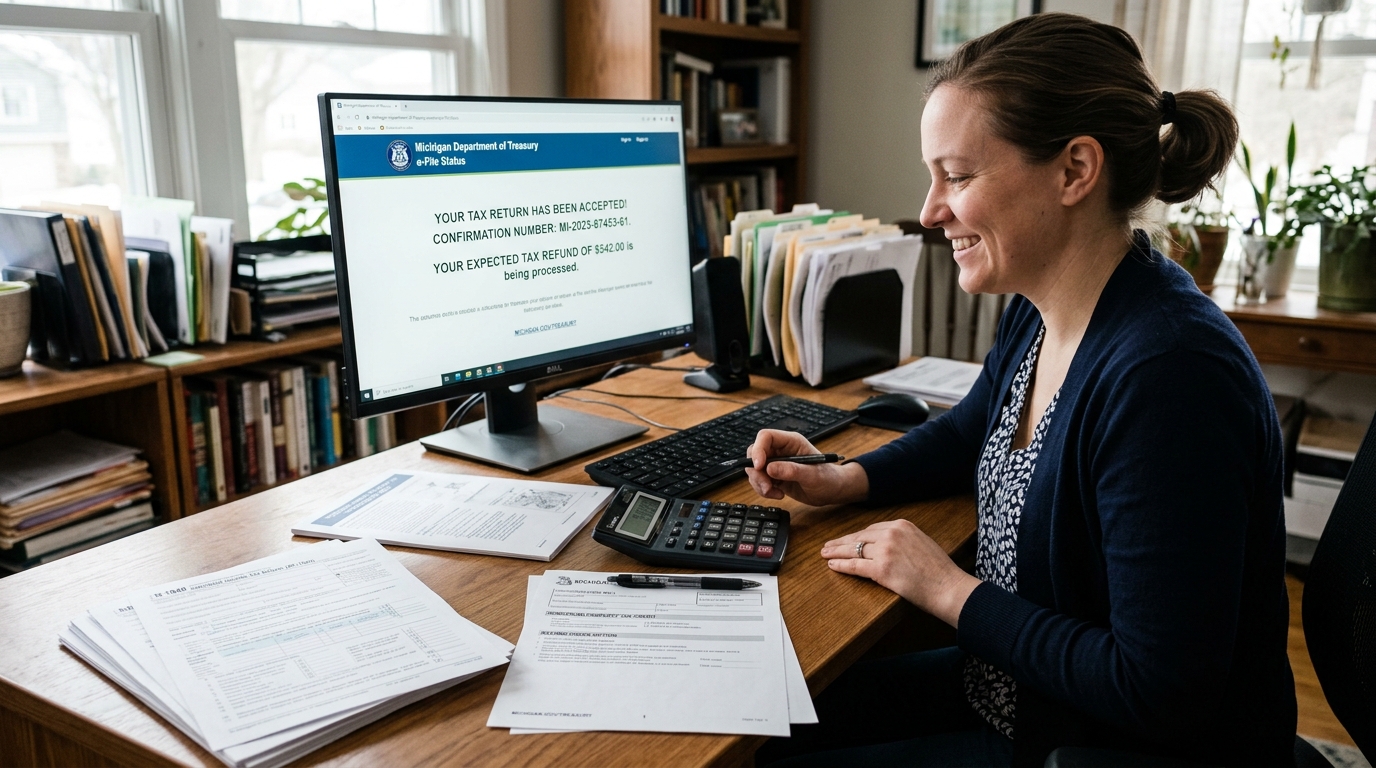
Every filing season, more than five million Michigan residents submit individual income tax returns to the Michigan Department of Treasury. For working families, seniors, and telecommuting professionals across Southeast Michigan and the Upper Peninsula, annual state tax refunds represent essential household liquidity—averaging between \$600 and \$2,800 depending on earned wage withholdings, property tax credits, and the state’s expanded Working Families Tax Credit.
However, navigating the state’s disbursement timeline is often complicated by security reviews, banking Automated Clearing House (ACH) schedules, and automated verification protocols. Knowing precisely when your refund will arrive, how to query the official Michigan Treasury tracker, and how to rectify processing holds can mean the difference between immediate direct deposit and months of delayed correspondence.
This comprehensive guide breaks down the 2026 Michigan Department of Treasury refund processing architecture, publishing historical batch schedules, step-by-step instructions for the state’s digital tracking portal, identity verification procedures, and municipal Detroit tax refund protocols.
Bottom Line Up Front (BLUF): Michigan Refund Processing Benchmarks (2026)
• Electronically Filed (e-File) with Direct Deposit: Average delivery in 14 to 28 calendar days (allow up to 4 to 6 weeks before submitting inquiries under official Treasury guidelines).
• Paper Filed by Mail: Standard processing timeline is 6 to 8 weeks from receipt (can extend to 10 to 12 weeks during peak March–April surges).
• Primary Tracking Tool: Official Michigan Department of Treasury e-Services portal (treas-secure.state.mi.us or michigan.gov/taxes). Statuses update once daily overnight from Monday through Friday.
• Required Tracking Inputs: Primary Filer SSN/ITIN, Primary Last Name, Tax Year, Filing Status, and exact Adjusted Gross Income (AGI) or Total Household Resources (THR).
1. 2026 Michigan State Tax Refund Schedule: E-File vs. Paper Returns
The Michigan Department of Treasury processes individual returns using an automated batch queue that integrates computerized wage cross-referencing with risk-scoring algorithms. Unlike the Internal Revenue Service (IRS), which adheres to fixed weekly transaction cycles, the Michigan Treasury processes refunds continuously, releasing direct deposits each banking day following overnight settlement.
The table below outlines projected processing windows and direct deposit dates across the 2026 filing season:
| Date Return Accepted / Received | Filing Method | Disbursement Method | Estimated Refund Arrival Window |
|---|---|---|---|
| Late January (Opening Week) | e-File (Approved) | Direct Deposit | Mid-February (Feb 10 – Feb 20) |
| Early February (Feb 1 – Feb 15) | e-File (Approved) | Direct Deposit | Late February to Early March |
| Mid-February (Feb 16 – Feb 28) | e-File (Claiming EITC/Property Credit) | Direct Deposit | Early to Mid-March (after credit audit) |
| Early March (Peak Volume) | e-File (Standard) | Direct Deposit | Mid to Late March (14–21 business days) |
| Late March to April 15 | e-File (Deadline Surge) | Direct Deposit | Mid-May to Late May |
| Any Date During Season | e-File (Standard) | Paper Check via USPS | Add 10 to 14 business days for postal transit |
| February Mailings | Paper Return (Mailed Form MI-1040) | Paper Check or Deposit | Late March to Mid-April (6–8 weeks) |
| April Mailings | Paper Return (Mailed Form MI-1040) | Paper Check or Deposit | Late June to Mid-July (8–12 weeks) |
Why Direct Deposit Is Vastly Superior
Taxpayers opting for direct deposit receive their state funds up to three to four weeks faster than those requesting paper checks. Paper disbursements must be printed at the state’s central treasury facility in Dimondale, bundled, transferred to the United States Postal Service (USPS), and delivered through local transit routes. Furthermore, paper checks carry higher risks of interception, mailbox theft, or forwarding errors following residential address changes.
2. How to Use the Official Michigan “Where’s My Refund?” Tracker
The official online portal for tracking Michigan state tax returns is managed under the Michigan Treasury Individual Income Tax e-Services platform. Taxpayers should exercise caution to avoid third-party copycat websites that charge fees or collect sensitive personal data.
To safely check your refund status online:
Step 1: Gather Required Tax Documents
Before accessing the portal, you must have an exact copy of your filed Form MI-1040 (Michigan Individual Income Tax Return) or Form MI-1040CR (Homestead Property Tax Credit Claim).
Step 2: Navigate to Treasury e-Services
Visit the official state portal at michigan.gov/taxes and select Individual Income Tax, then click “Check My Income Tax Info / Where’s My Refund”. Alternatively, access the secure server directly at treas-secure.state.mi.us.
Step 3: Enter the Five Mandatory Verification Fields
To protect taxpayer confidentiality under Section 205.28 of the Michigan Compiled Laws, the system enforces a strict zero-tolerance authentication check. You must input:
- Primary Social Security Number (SSN) or ITIN: If you filed Married Filing Jointly, input the SSN of the spouse listed first on the return.
- Primary Taxpayer Last Name: Must match the spelling on your filed return exactly, including hyphens or suffixes.
- Tax Year: Select 2026 (or prior years if tracking an amended return).
- Filing Status: Select Single, Married Filing Jointly, Married Filing Separately, Head of Household, or Qualifying Surviving Spouse.
- Adjusted Gross Income (AGI) or Total Household Resources (THR):
- If you filed Form MI-1040: Enter the exact dollar amount of your Michigan AGI from Line 10.
- If you filed Form MI-1040CR (Homestead Credit) without an MI-1040: Enter the Total Household Resources from Line 33.
- Note: Do not enter commas, periods, or dollar signs. Enter whole dollars only.
Authentication Checklist for Michigan Treasury e-Services:
[✓] Primary Taxpayer's 9-digit SSN (No hyphens)
[✓] Primary Taxpayer's Legal Last Name
[✓] Tax Year Selection (e.g., 2026)
[✓] Legal Filing Status Matching Form MI-1040
[✓] Exact Whole-Dollar AGI (MI-1040, Line 10) OR THR (MI-1040CR, Line 33)
System Update Schedule
The Michigan Treasury database does not update continuously throughout the day. Batch records update once every 24 hours overnight from Monday through Friday (excluding state holidays). Checking the system multiple times within the same day will not produce new information.
3. Decoding Your Refund Tracker Status Stages
When querying the Michigan Treasury e-Services tracker, your file will progress through several distinct status indicators:
1. “Return Received — Processing”
This status confirms that the state’s electronic data interchange (EDI) has ingested your e-file or Treasury personnel have scanned your paper submission. At this stage, your return has entered the automated intake queue.
2. “In Processing / Additional Review”
Your return is actively undergoing automated cross-matching against third-party records. Treasury systems automatically match W-2 and 1099 wage and withholding data against quarterly reports submitted by Michigan employers. If your return includes refundable credits—such as the Michigan Homestead Property Tax Credit or the Michigan Working Families Tax Credit (EITC)—it undergoes mathematical validation.
3. “Action Required / Correspondence Sent”
This indicates an administrative hold. The state has paused processing and generated an official written notice mailed to the address on record. The most common notices are Form 5122 (Identity Confirmation Notice) or requests for missing wage statements (Schedule W).
4. “Refund Approved / Scheduled for Payment”
All audit filters, wage reconciliations, and debt offset screenings have cleared. The system will display the approved refund amount and the scheduled issue date.
5. “Refund Issued / Direct Deposit Sent”
The funds have been transmitted via the Federal Reserve ACH network to your banking institution, or a physical Treasury check has been delivered to the postal service.
4. Resolving Identity Verification Holds: Form 5122 & Online Quiz
To protect Michigan residents from sophisticated identity theft syndicates that file fraudulent tax returns using stolen credentials, the Department of Treasury deploys machine-learning fraud detection filters. If your return triggers a risk parameter, Treasury will temporarily suspend refund issuance and mail you an official letter: Form 5122 (Identity Confirmation Notice).
Do Not Panic if You Receive Form 5122
Receiving an Identity Confirmation Notice does not mean you are under criminal audit or made a computational error. It simply means the state’s security algorithm flagged your return for identity confirmation—frequently triggered by a recent address change, new bank routing number, first-time filing in Michigan, or substantial credit fluctuations.
Step-by-Step Identity Resolution Protocol:
- Locate the Letter Code: Your Form 5122 contains a unique multi-digit Reference Code and Letter ID printed in the upper right quadrant.
- Access the Michigan Identity Quiz: Visit the secure state portal at
michigan.gov/taxesand click the “Identity Verification” link. - Complete the 5-Minute Authentication Quiz: You will be presented with four to five dynamic security questions generated from public and commercial credit databases (e.g., previous mortgages, automotive financing, prior residential addresses).
- Passing the Quiz: If you answer the security questions correctly, your identity is authenticated immediately. The hold is lifted within 24 to 48 hours, and your refund returns to the active disbursement queue, typically arriving within 2 to 3 weeks.
- Alternative Document Submission: If you fail the online quiz or cannot access the digital system, you must mail or fax copies of:
- A valid government-issued photo ID (Michigan Driver’s License or U.S. Passport).
- Your Social Security card.
- Copies of all Form W-2s, 1099s, and property tax statements supporting the return.
- Note: Manual document verification can take 6 to 8 weeks to finalize.
5. Why Is My Michigan Refund Delayed? Common Audit Triggers
If your refund has been pending beyond the standard 28-day window without an approved payment date, one of the following structural issues is likely responsible:
A. The Expanded Michigan Working Families Tax Credit (EITC)
Under Public Act 4 of 2023, Michigan quintupled its state Earned Income Tax Credit from 6% to 30% of the federal credit. Because this represents thousands of dollars in refundable capital per qualifying household, Michigan Treasury subjects EITC returns to enhanced anti-fraud verification. Returns claiming this credit filed early in January or February are held until employer wage records are fully reconciled against Treasury databases in mid-to-late February.
B. Employer W-2 Reporting Delays (Schedule W Discrepancies)
When you file your Michigan return, you report state withholding on Schedule W (Withholding Tax Schedule). Simultaneously, your employer must submit annual wage reports (Form 5081) to the state. If your employer’s payroll company submits their state filings late or reports an EIN that does not match your W-2 Box 15, the state’s automated matching engine flags your refund for manual intervention.
C. Homestead Property Tax Credit Claims (Form MI-1040CR)
Claiming the Michigan Homestead Property Tax Credit (up to \$1,700 for qualifying homeowners and renters) requires detailed verification of Total Household Resources (THR). If your reported property taxes exceed the statutory percentage of your income or your landlord’s property tax information conflicts with municipal assessment rolls, Treasury will pause the refund to verify eligibility.
Common Delay Factors & Average Resolution Times:
• Identity Verification (Form 5122): 14–21 days after quiz completion.
• Missing Schedule W Withholding Data: 30–60 days pending employer wage match.
• Homestead Credit Property Tax Audit: 4–6 weeks for municipal record cross-check.
• Bank Account Number Rejection: 14 business days (Direct deposit converts to paper check).
6. Understanding Michigan Debt Offsets: Intercepted Refunds
Under Section 205.30a of the Michigan Compiled Laws, the Department of Treasury is legally mandated to apply individual income tax refunds toward outstanding debts owed to the state or federal government before releasing funds to the taxpayer.
What Debts Can Intercept Your Michigan Tax Refund?
- Delinquent Michigan State Taxes: Unpaid individual income, business, or sales taxes from prior tax years.
- Child Support Arrearages: Past-due child support certified through the Michigan State Disbursement Unit (MiSDU) and county Friend of the Court offices.
- Unemployment Insurance Agency (UIA) Overpayments: Restitution or benefit overpayments administered by the Michigan Department of Labor and Economic Opportunity (LEO).
- Court Fines and Municipal Restitution: Unpaid criminal penalties, court costs, or statutory victim restitution fees certified by Michigan district and circuit courts.
- State University Tuition Debts: Delinquent student loan obligations or default accounts owed to public Michigan universities.
- Federal Debts (Treasury Offset Program): Delinquent federal taxes administered by the IRS, federal student loans, or other federal agency obligations.
The Offset Notification Process
If your refund is intercepted to pay a debt, Treasury will mail an official Notice of Intent to Offset. The notice outlines: * The original approved refund amount. * The specific creditor agency claiming the funds (including their agency case number and telephone contact). * The net dollar amount deducted. * Any remaining balance to be refunded to your bank account or mailed as a check.
Taxpayers have a statutory right to contest an offset within 30 days of notice, but disputes regarding the validity of the underlying debt must be handled directly with the intercepting agency (e.g., the Friend of the Court or UIA), not the Department of Treasury.
7. Direct Deposit Banking Mechanics & ACH Clearing
Once Michigan Treasury issues your direct deposit, the transaction passes through the Automated Clearing House (ACH) network administered by the Federal Reserve Bank.
| Treasury Issue Day | ACH Network Transmission | Traditional Bank / Credit Union Posting | Early-Pay Fintech Accounts |
|---|---|---|---|
| Monday | Monday Night | Wednesday Morning | Tuesday Afternoon |
| Tuesday | Tuesday Night | Thursday Morning | Wednesday Afternoon |
| Wednesday | Wednesday Night | Friday Morning | Thursday Afternoon |
| Thursday | Thursday Night | Monday Morning | Friday Afternoon |
| Friday | Friday Night | Tuesday Morning | Monday Afternoon |
Common Banking Failures: Rejection and Paper Check Conversion
If you entered an incorrect bank routing or account number, or if the receiving account is closed or does not accept direct deposits in the primary filer’s name: 1. The receiving bank rejects the ACH transfer within two to three business days and returns the capital to the Michigan Department of Treasury. 2. Treasury security protocols automatically freeze electronic transfers to prevent fraud. 3. The system converts the refund into a physical paper check, which is printed and mailed via USPS to the primary taxpayer address on the return within 10 to 14 business days.
8. City of Detroit Municipal Tax Refunds: Form D-1040
A distinctive attribute of Michigan taxation is that municipal income tax administration for the City of Detroit has been handled directly by the Michigan Department of Treasury since 2016 through the City Tax Administration division.
For hybrid professionals and remote workers commuting into Detroit who overpaid the city’s 1.2% non-resident tax or residents subject to the 2.4% rate, municipal refunds are claimed via City Form D-1040 or Form D-1040(NR).
Tracking Your City of Detroit Refund
City of Detroit tax refunds are not issued as a combined single payment with your Michigan state refund. They are processed through separate accounting queues. You can track your Detroit refund on the same Michigan Treasury e-Services portal by toggling from "Individual Income Tax" to "City Income Tax".
For a granular breakdown of how remote employees calculate days-worked exemptions under Schedule N to maximize their municipal Detroit refund, consult our in-depth analysis on Detroit Remote Worker Tax Withholding & Refund Filings. For overall metropolitan tax rates, read our foundational Michigan and Detroit City Tax Guide.
9. Troubleshooting: What to Do If Your Refund Is Missing
If your return has been acknowledged for more than six weeks (e-file) or ten weeks (paper) and the online tracker displays no status updates, take the following structured steps:
1. Check with Your E-File Software Provider
Verify that your return was not merely transmitted, but officially accepted by the State of Michigan. Check your filing confirmation email for the 14-digit Michigan State Electronic Filing Acknowledgment ID. If the return was rejected due to an incorrect dependent SSN or PIN error, it was never received by Treasury.
2. Contact the Automated Phone System
If you do not have internet access or want to confirm the online tracker results, call the Michigan Treasury automated voice-response system at:
* Michigan Individual Income Tax Hotline: (517) 636-4486
* Available 24/7. Have your SSN, tax year, filing status, and exact whole-dollar AGI ready.
3. Submit a Secure Digital Inquiry via e-Services
Log into the Michigan Treasury e-Services portal and submit an authenticated electronic message through the “Customer Inquiries” feature. Responses are generally delivered to your secure portal inbox within 5 to 7 business days.
4. Speaking with a Live Treasury Agent
To reach a live customer service representative regarding complex holds, dial (517) 636-4486 during standard state business hours (Monday through Friday, 8:00 AM to 4:45 PM EST). For the shortest queue times, place calls on Wednesday or Thursday between 8:00 AM and 9:30 AM EST.
10. Frequently Asked Questions (FAQ)
How do I check the status of my Michigan state tax refund?
Navigate to the official Michigan Department of Treasury Individual Income Tax e-Services platform at michigan.gov/taxes. Click on “Check My Income Tax Info / Where’s My Refund” and supply five authentication metrics: primary filer Social Security Number or ITIN, primary last name, tax year, legal filing status, and exact whole-dollar Adjusted Gross Income (AGI) from Line 10 of Form MI-1040 (or Total Household Resources from Line 33 of Form MI-1040CR).
How long does a Michigan state tax refund take in 2026?
Electronically filed returns with direct deposit are typically processed and deposited within 14 to 28 calendar days. Paper-filed returns submitted by mail require 6 to 8 weeks (extending up to 12 weeks during peak March and April filing volumes).
Does Michigan release refunds on weekends?
No. The Michigan Department of Treasury processes refund disbursements on banking business days (Monday through Friday, excluding official state and federal holidays). Automated Clearing House (ACH) direct deposits are posted by commercial financial institutions on business days only.
What should I do if my refund status says “Action Required”?
An “Action Required” status indicates that Treasury has placed an administrative hold on your file and mailed an official written correspondence. Check your mailbox for Form 5122 (Identity Confirmation Notice) or an information request regarding Schedule W withholding. Complete the requested online identity quiz or submit the requested documentation promptly to release the hold.
Can the state take my tax refund for past-due child support or unemployment overpayments?
Yes. Under Michigan Compiled Laws Section 205.30a, Treasury is authorized to intercept tax refunds through statutory third-party debt offsets. Certified child support arrears from the Friend of the Court, restitution owed to the Michigan Unemployment Insurance Agency (UIA), delinquent state taxes, and court restitution will be deducted prior to releasing any remaining funds.
Summary & Actionable Checklist
To ensure your Michigan individual tax refund is processed and deposited without administrative friction, adhere to this pre-filing and post-filing protocol:
- [ ] Verify E-File Acceptance: Confirm receipt of your 14-digit Michigan state acceptance confirmation code from your tax preparation software.
- [ ] Safeguard AGI Figures: Retain a physical copy of Form MI-1040 to reference exact Line 10 AGI or Line 33 Total Household Resources when querying e-Services.
- [ ] Monitor Physical Mail: Keep a watchful eye for official correspondence from the Michigan Department of Treasury (especially Form 5122).
- [ ] Avoid Multiple Daily Queries: Check the e-Services tracker once daily, as the database updates strictly overnight on weekdays.
- [ ] Verify Municipal Deductions: If you work in Detroit or reside in one of Michigan’s 24 taxing municipalities, ensure you file the corresponding municipal return (such as Form D-1040) to capture separate local tax refunds.
Archival & Citation Notice
This research analysis is published under the academic and civic archive of Detroit Focus. For academic referencing or press reproduction, please cite as: "Michigan State Tax Refund Status 2026: Direct Deposit Dates, Schedule & Where's My Refund Tracker", Detroit Focus Urban Review (September 29, 2026).